

Why Client Testimonials Are A MUST For Your Website (And How To Generate Better Ones)

Avocado toast has been on restaurant menus since the 1990s, but it made it big in the mid to late 2010s and hasn’t looked back.
Thanks to us millennials...
You couldn’t turn on a cooking show, scroll on Instagram, or have brunch without seeing avocado toast. It was everywhere. In fact, by 2021, over 3,022 million pounds of avocados were consumed annually.
❓Do people order avocado toast because they love it? Maybe.
❓Do they order it because it is marketed to consumers as a healthy meal? Also, maybe. They’re healthy fats…duh.
❓Do they order it because millennials took the craze to Instagram and never ate it again without posting about it? YES.
Frankly, I don’t think 🥑avocados ever saw millennials coming.
As a business owner, you know the importance of asking people to write you a review on Google or tell their friends and family about your business, but do you also consider the importance of client testimonials on your website?
Avocado toast is proof that reviews are everything when it comes to popularity and a craze. This is why you shouldn’t overlook the importance of using client reviews and testimonials to your advantage. They are vital to the success of your conversion rates on your website.
Benefits of Testimonials
As a service provider, you rely on the loyalty and success of your clients to continue to grow and flourish in business. Providing testimonials helps build trust and credibility for your brand by showing others that you provide a valuable service.
Humans innately like to do things that other humans are doing. This is where the idea of social proof came from.
The term was coined by Robert Cialdini, an American psychologist, in the 1980s. He defines it as “a psychological and social phenomenon wherein people copy the actions of others in choosing how to behave in a given situation.”
Using testimonials that speak to another customer's success with your business will influence the reader's decision-making.
Another benefit of using strategic testimonials is that you can get into the reader's head and heart by using testimonials that speak directly to who you are, what you do, and how you do it differently. This is key when trying to build trust and credibility with someone who has never interacted with your brand before.
When hiring a service provider, consumers want to know that the person providing their service cares about them and their business.
Studies have proven this to be true. Let’s take a look at some facts.
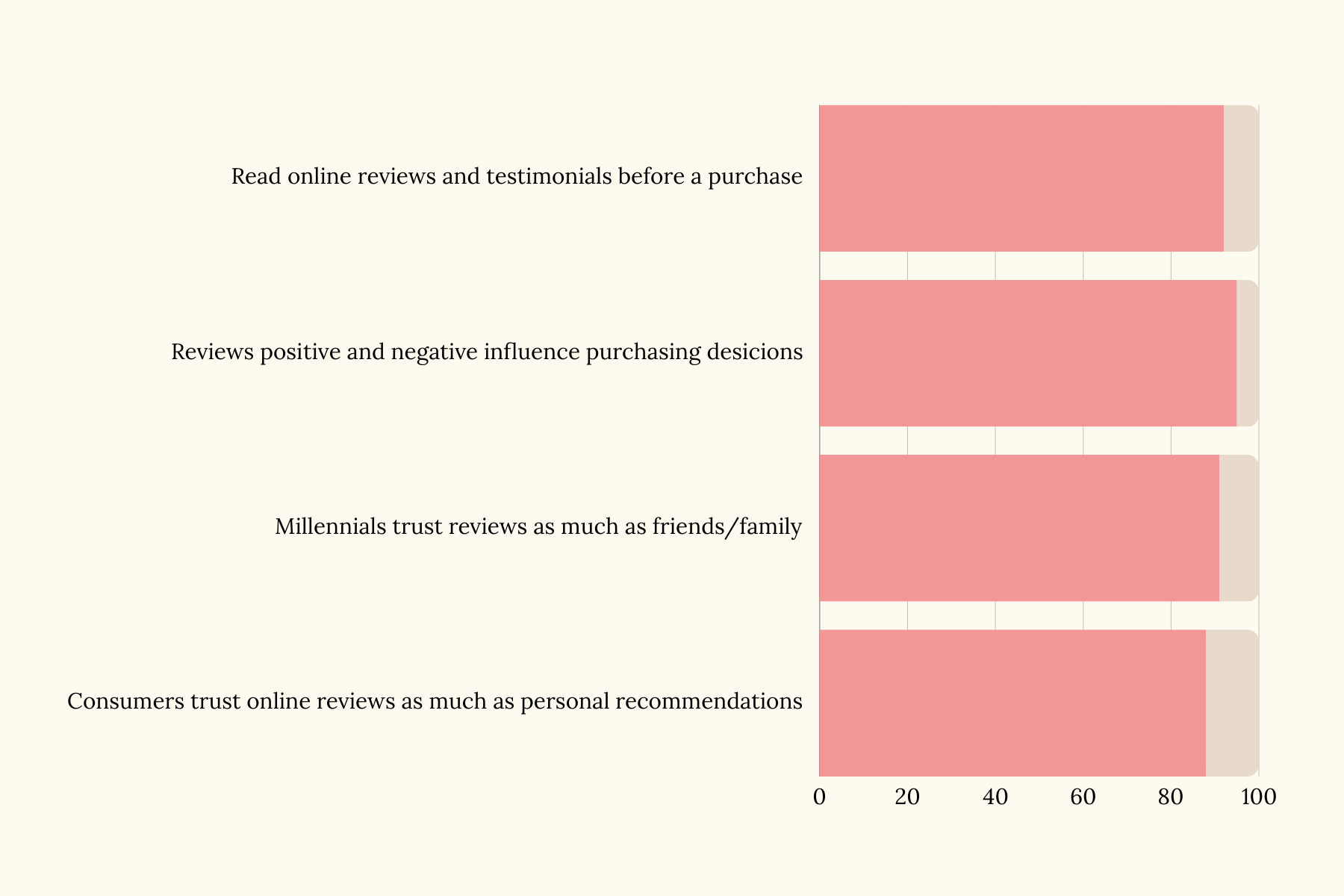
Knowing these statistics allows you to provide your website visitors with compelling testimonials that increase conversions.
Tips for Generating Better Testimonials
When you are just starting out in business, asking for testimonials might give you the ICK, but don’t let it. If you are a service provider asking other business owners for testimonials, they totally get it.
Because they are asking their clients for testimonials, too.
Ask for testimonials quickly
If you provide a service like mine where weeks are passing before the project is complete, be sure to ask them for the testimonial before the final day of the project.
If you provide a one-day service, like a photographer, for example, have your feedback request automated so it can be sent the same day that you provide the service.
Rely on the right clients for testimonials
The harsh reality is that some clients aren’t the right ones for testimonials, and that is okay. Rely on your most collaborative and responsive clients for testimonials.
Make it easy to provide feedback
Sending an email asking for a testimonial likely isn’t going to get you very many. You need to make it easy for them to provide you with feedback.
Ask specific questions
Do not rely on your clients to come up with feedback on their own. Many people might end up writing nothing because they are intimidated by the blank page. Give the client testimonial questions so they have a jumping-off point.
Create a System for Collecting Testimonials
Creating systems within your business helps you be more effective. This is why we send canned emails and have workflows in our CRMs. It shouldn’t be different for collecting feedback from clients.
Here are a few ways you can collect feedback from clients:
→ Send a form
If you use a customer relationship management system like Dubsado or Honeybook, this is an amazing option. You can create the form and have a workflow set up to send them the feedback form on a specific date. Set it and forget it!
→ Upload questions to your client portal
This is what I do in my business. Following a client signing a contract and paying their deposit, I send them their own client portal in Notion. This houses all project files, schedules, meeting invites, task lists, all communication, and the list goes on. So for my business it makes sense to request feedback in the client portal.
Simply add questions and answer boxes to a blank page in your project management system of choice.
→ Send a fillable client review template via email
If you don’t use a CRM or project management system, you can simplify things and email them a fillable PDF. You can create one in Canva or stick around until the end for a free resource where I’ve done all the work for you.
Implementing Testimonials on Your Website
Are you asking yourself, “so that’s great and all, but once I receive feedback, where the heck do I put it on my website?”
Let’s take a look at examples of some common pages on a service provider's website.
☆ For Your Homepage
These should be general testimonial questions speaking about your business as a whole. For example: What would you tell someone who is considering my services?
This will help someone who is seeing your business for the first time understand what you do and who you do it for.
☆ For Your About Page
These questions should be specific to you. What sets you apart? How do you do things differently? Why should they choose you over a competitor?
Here you are talking about you but getting someone else to say it. Think, “my mom says I’m cool” sticker…but cooler. 👏
☆ For Your Services Page
The best questions to use here are transformation questions like before-and-after scenarios. They speak to the results your service provides, and we all want results out of our investments, right?
You can also use generic questions here like you do on your homepage!
☆ For Your Contact Page
Did someone specifically mention your communication skills or style in some of your about page questions? If so, please include those here!
Asking specific questions allows you to get more than one testimonial from each client, which you can then place across your website, increasing the chance of website visitors seeing them.
Download Your Free Customizable Client Testimonial Questionnaire
As we’ve seen throughout this post, having testimonials on your website is vital to your business's growth. With my free resource, a customizable Client Testimonial Questionnaire, you can start getting that feedback now.
In this free resource, you will receive:
✔ A questionnaire with strategically asked questions to use on all the typical pages of a website
✔ The questionnaire is delivered to you through a Canva template so you can customize it to your brand
✔ Two video tutorials showing you how to use the freebie
✔ Instructions on exactly where to put the feedback on your website once you receive it
If you decide to use your CRM or client portal, this freebie will still be useful. Steal my questions, put them in your form or portal, and start getting the feedback you’ve been wanting all along.
New around here? Welcome!
I’m Katie, a Squarespace website designer focused on building websites for service-based business owners.
I’d love to stay in touch if you liked what you read.
Here’s where you can find me:



After three and a half years in business, there are a few things I’d do differently if I were starting over. From market research and clearer offers to better messaging, consistent marketing, and going all in sooner, these are the five things I wish I had figured out earlier.